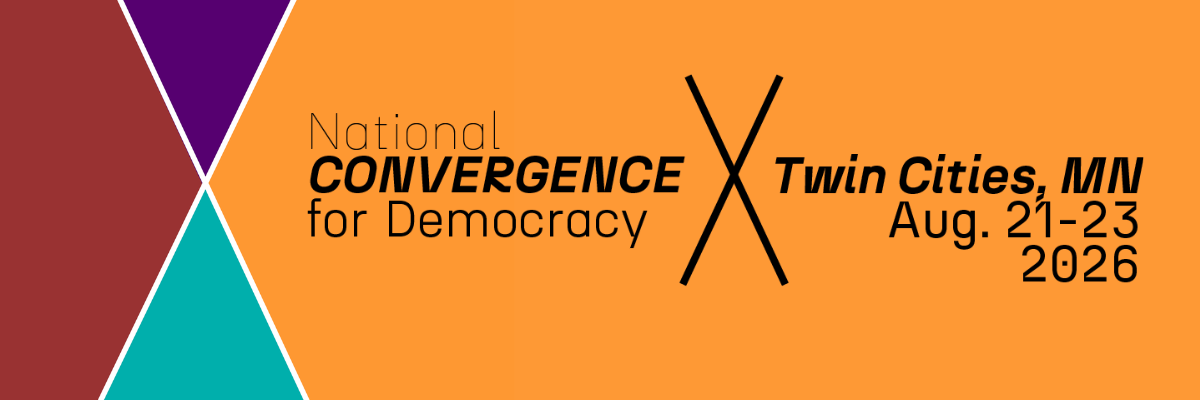
The National Convergence for Democracy is a three-day gathering in Minneapolis, MN from Friday, August 21 to Sunday, August 23 led by Tending the Soil and designed to bring together community, grassroots, and frontline organizers and leaders from across the country who want to skill-share and coordinate the next iteration of democracy defense in the United States.
FAITH LEADERS ANSWERING HISTORY
IN A TIME OF PERIL AND POSSIBILITY
join the convergence faith stream
Faith communities have long played critical roles in movements for democracy, human dignity, and collective liberation. They offer more than volunteers and institutional resources. They cultivate moral imagination, sustain communities through crisis, provide practices that nurture courage and resilience, and help people act together in ways that challenge injustice while affirming human dignity. Drawing on lessons from Minnesota's response to Operation Metro Surge and from faith-rooted movements across traditions, the Faith Stream— led by MARCH and Jewish Community Action and facilitated by multiracial and multifaith leaders across the Twin Cities— will explore how religious and spiritual communities can strengthen resistance to authoritarianism while helping build the democratic future we seek.
Join the faith leaders who led targeted communities through Operation Metro Surge, issued January’s nationwide Call to Minneapolis, stood up community-centered mutual-aid networks, held and held up the indigeneity of Mni Sota Makoce, and went to federal court and won the right to offer pastoral care to federal detainees for these sessions:
-
Faith communities have historically played important roles in campaigns of non-cooperation and nonviolent resistance. This advanced training is designed for faith leaders who have completed the Freedom Trainers' introductory non-cooperation training and are ready to move from analysis to implementation.
Participants will:
Map relationships within and beyond their congregations through social location assessments and the pillars of support framework.
Use liberatory eco-mapping tools to identify opportunities for action grounded in relational forms of organizing that model and advance a more just future.
Design a concrete next step toward an existing or emerging non-cooperation campaign that leverages faith “super-powers.”
-
Organizing in repressive environments takes a profound emotional, physical, and spiritual toll. Burnout, trauma, grief, and exhaustion are not personal failures; they are predictable consequences of sustained struggle. Yet religious, spiritual, and cultural traditions have long cultivated practices that help communities endure hardship, remain grounded, and continue working for liberation. This interactive session will explore spiritual and somatic practices drawn from diverse traditions, including contemplative practice, communal singing, embodiment work, ritual, storytelling, and collective healing. Participants will consider how these practices can sustain organizers, strengthen communities, and help movements weather periods of uncertainty and repression. Special attention will be given to making these practices accessible to people who are not part of faith communities and to those who carry wounds from harmful religious experiences and communities.
-
Movements require strategy, but they also require meaning. Throughout history, communities have used ritual, ceremony, prayer, pilgrimage, music, and public symbols to resist oppression, honor those who have suffered, and tell alternative stories about who we are and what is possible. Drawing on examples from Indigenous traditions, immigrant justice organizing, interfaith actions, memorial gatherings, pilgrimages, and public worship services held during Operation Metro Surge, this session will explore how sacred practices can transform public space, deepen solidarity, and help communities grieve, remember, and act. Participants will examine the power of ritual both as a form of resistance and as a way of sustaining communities through periods of crisis and loss.
-
Authoritarian movements thrive when communities become isolated, fearful, and dependent upon institutions that may no longer serve them. Mutual aid offers a different vision—one rooted in solidarity, reciprocity, and collective care. Faith communities are uniquely positioned to support this work. Congregations, mosques, synagogues, temples, and other faith institutions often possess physical space, volunteer networks, trusted relationships, and long-standing traditions of caring for neighbors. This session will explore how faith communities can organize and support mutual aid efforts, serve as hubs for resource distribution and community care, and help build the alternative structures necessary for communities to withstand political and social crises. Participants will hear practical lessons from faith organizers who have built mutual aid networks in response to immigration enforcement, economic hardship, and community emergencies.
-
“Those closest to the pain should be closest to the power” -Ayanna Pressley.
As authoritarian movements target particular communities, faith-based resistance must be shaped by the wisdom, leadership, and priorities of those most directly affected. Too often, solidarity efforts unintentionally reproduce unequal power dynamics or place additional burdens on already traumatized communities. This session will center the voices of faith leaders and organizers from faith communities currently experiencing heightened threats and surveillance, including immigrant, Muslim, LGBTQ+, and other targeted communities. Together, participants will explore what meaningful solidarity looks like in practice, how to avoid common mistakes, and how communities with greater privilege or institutional protection can effectively support movements led by those most at risk. Participants will leave with practical guidance for building accountable relationships and organizing in ways that shift power rather than simply expressing support.
-
Across the country, faith communities are responding to the expansion of immigration detention through accompaniment, pastoral care, advocacy, legal support, public witness, and campaigns to prevent the construction of new detention facilities. This session will bring together organizers, clergy, legal advocates, and community leaders to share lessons learned from work at detention centers and in communities impacted by detention. Participants will explore strategies for supporting detained individuals and their families, building local resistance campaigns, coordinating faith-based accompaniment efforts, and developing networks of care across state lines. The session will also provide space for participants to connect with others engaged in similar work and to explore opportunities for ongoing collaboration beyond the Convergence.
meet our partners